
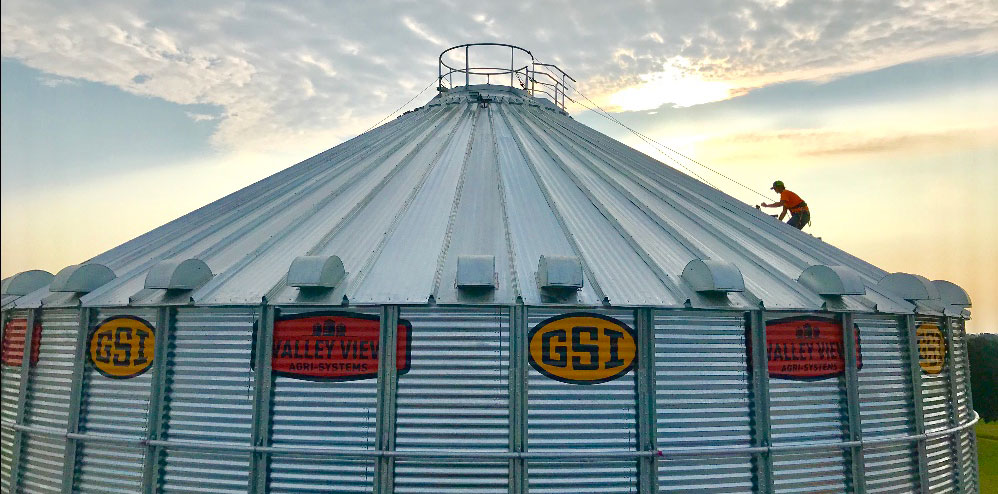
Choosing the right roof for your grain bin is about more than looks. It affects how your grain performs in storage, how easily you can monitor conditions, and how much long-term maintenance — and risk — you’ll face. At Valley View Agri-Systems we help producers pair the best roof system with their operation’s size, climate, and monitoring needs so your grain storage works harder and smarter for you.
Why the roof matters for grain storage
The roof is your first line of defense against weather, moisture intrusion, and pests. It also determines how easy it is to run cables, mount gateways, or install grain bin sensors without compromising the bin’s integrity. A smart roof choice improves ventilation, reduces moisture hotspots, and supports whatever monitoring system you plan to add now or later.
Common roof types and what they mean for your operation
- Single-cone / conical roofs — Are simple and cost-effective, designed with good drainage and are straightforward to fit with basic vents and access ports. If you plan to run a few sensor cables, make sure there are sealed penetrations or factory-installed conduits.
- Multi-segment or ribbed roofs — Often stronger under snow/wind loads and could offer better anchoring points for antennae or sensor gateways. Check with your grain bin construction company about approved mounting locations to avoid weakening the roof.
- Hopper roofs (for small bins or specialty storage) — Great for gravity unloading but typically trickier for running sensor wiring and placing walkways. Plan sensor locations early.
- Insulated or lined roofs — Helpful in extreme climates to reduce condensation and temperature swings; they can complicate cable routing and require planning for conduit runs.
Key criteria when selecting a roof system
- Climate and load capacity — Snow, ice, and wind loads drive structural requirements. Pick a roof rated for your region — it protects the grain and any equipment mounted on the roof.
- Access & maintenance — Consider roof walkways, ladder tie-offs, and access hatches for safe sensor installation and routine checks.
- Waterproofing & seals — Leaky seams create spoilage. Look for factory-sealed penetrations or plan to add weatherproof conduit and gland seals where sensors or cables will pass through.
- Mounting & penetrations — If you’ll add antennae, gateways, or solar panels for wireless sensors, you need designated mounting points and reinforced areas.
- Compatibility with aeration systems — Roof vents and aeration intakes should play nicely with your ventilation plan to avoid short-cycling air and creating hotspots.
- Longevity & corrosion resistance — Roofing material and coatings affect lifespan; consider galvanized or coated steel that matches bin walls for consistent service life.
Planning for grain bin sensors and cable runs
If you intend to use grain bin sensors (temperature probes, CO₂, moisture sensors, or cable-based temperature systems), plan the roof and installation at the start — not as an afterthought.
- Decide sensor type early. Cable-based temperature systems require conduit or bulkheads for safe entry; wireless sensors need gateway placement with reliable connectivity. Knowing which you’ll use defines roof penetrations and mounting needs.
- Designate conduit risers and sealed penetrations. Properly routed conduit eliminates repeated roof drilling and maintains seals. Ask your grain bin construction company to include factory-installed conduit options.
- Provide a maintenance route. Technicians will need safe access to sensor gateways and antennae. Roof walkways, handrails, and anchor points matter.
- Locate gateways for signal strength. Metal bins block radio signals — gateways may be roof-mounted with an external antenna or placed nearby in a weatherproof enclosure. Plan power and grounding.
- Protect from condensation and extreme temps. Roof insulation or ventilation choices can influence sensor accuracy and longevity. Ensure sensors are specified for the expected temperature range and protected from moisture.
- Follow electrical and safety codes. Any powered equipment on the roof (gateways, repeaters) must meet local electrical and explosion-safety standards. Work with certified electricians and your grain bin construction company to stay compliant.
Practical installation tips
- Use factory-prepared penetration points where possible — they’re easier to seal and less likely to leak.
- When routing cables, avoid tight bends and sharp edges; use grommets and strain relief.
- Keep spare conduit capacity for future upgrades so you don’t have to drill new holes later.
- Label cables and document routing in an as-built drawing for future maintenance.
- Consider a weatherproof roof-mounted enclosure for wireless gateways to reduce cable runs and simplify power hookups.
Build smart from the top down
A roof that’s chosen with grain storage goals and monitoring plans in mind becomes an asset, not an obstacle. Whether your priority is long-term grain quality, low maintenance, or a monitoring setup that gives you real-time control, the roof decision ties directly into those outcomes. Working with an experienced grain bin construction company ensures roofing, structural, and electrical decisions are coordinated from day one — saving time, money, and headaches down the line.
If you’re evaluating new bins or retrofitting monitoring equipment, Valley View Agri-Systems can walk you through options tailored to your climate, budget, and monitoring strategy. Contact us to get a roof-and-sensor plan that protects your grain and your bottom line.