
Grain has been at the heart of agriculture for centuries — and for 250 years it’s been the engine behind some of the biggest advances in farm management. Here’s a readable tour through the past 250 years of grain management: the problems growers faced, the equipment and design advances that solved them, and practical lessons for today’s facilities.
From scythes to steam: the first big shifts (late 1700s – mid 1800s)
Early grain work was hand-powered and local: sickles and scythes, manual winnowing, and small, often porous storage that exposed grain to pests and moisture. Two inventions in the first half of the 19th century changed that:
- The mechanical reaper — associated with Cyrus McCormick — made harvests far faster and enabled larger fields and larger grain lots to be moved, stored, and marketed.
- The steam-powered grain elevator — developed by Joseph Dart and collaborators in Buffalo — mechanized unloading and storage at ports and railheads, transforming grain handling from a crew-intensive chore to an industrial flow process.
Why it mattered: mechanization shifted the problem set from “how do we cut and carry?” to “how do we move, store, and preserve much larger, consolidated volumes of grain safely and with minimal loss?”
The 20th century: scale, storage, and the science of keeping grain safe
As tractors, combines, and large elevators became common, new problems rose to the top:
- Moisture and temperature control. Bigger storage meant grain sat longer and developed hotspots, condensation, insect activity, and mold if not managed. Aeration fans, temperature cables, graduated ventilation, and engineered bin designs became essential. Extension research and design handbooks (like MWPS guides) standardized good practice in grain handling system design and aeration.
- Drying capacity and energy. High-capacity dryers and efficient drying protocols were developed to get wet grain to safe moisture quickly without damaging kernels. Manuals and extension guides have long warned about energy tradeoffs and kernel quality.
- Flow and safety issues. As bins grew, operators encountered bridging, ratholing, and dangerous entrapment risks. Design improvements (hopper angles, mass-flow designs) and flow aids (vibrators and sweeps) reduced blockages and improved operational safety.
Practical takeaway: a well-designed grain handling system design is about more than conveyors and bins — it’s about aeration paths, inspection points, sensible dryer sizing, and flow-friendly hopper geometry.
Recent decades: sensors, automation, and smarter decisions
The last 20 years have seen rapid adoption of monitoring and automation that turn reactive management into proactive control:
- In-bin sensors and remote monitoring. Temperature cables, wireless temperature/relative-humidity probes, and integrated dashboards let managers know when to run fans, when to probe, and when to move grain. Purdue and other land-grant programs promote scheduled monitoring and “SLAM”-style programs for stored grain.
- Gas and CO₂ monitoring. Newer research shows real-time CO₂ monitoring (along with T and RH) can give early warning of spoilage or insect activity — often before visible quality loss. That’s especially useful in big, dense bins where early hotspots are hidden.
- AI and data analytics. Emerging studies and commercial systems are applying machine learning to sensor streams to predict moisture trends, optimize aeration runs, and minimize dryer runtime while protecting quality.
That evolution means the phrase grain monitoring equipment no longer just means a handheld thermometer — it can mean a network of continuous sensors, alerts, and automated actuation tied into your farm or elevator control system.
Equipment advances that cut losses and labor (what “efficient” looks like)
Across the centuries the goal has stayed constant: deliver harvested bushels to market with as little loss as possible. A few equipment categories drove the biggest efficiency gains:
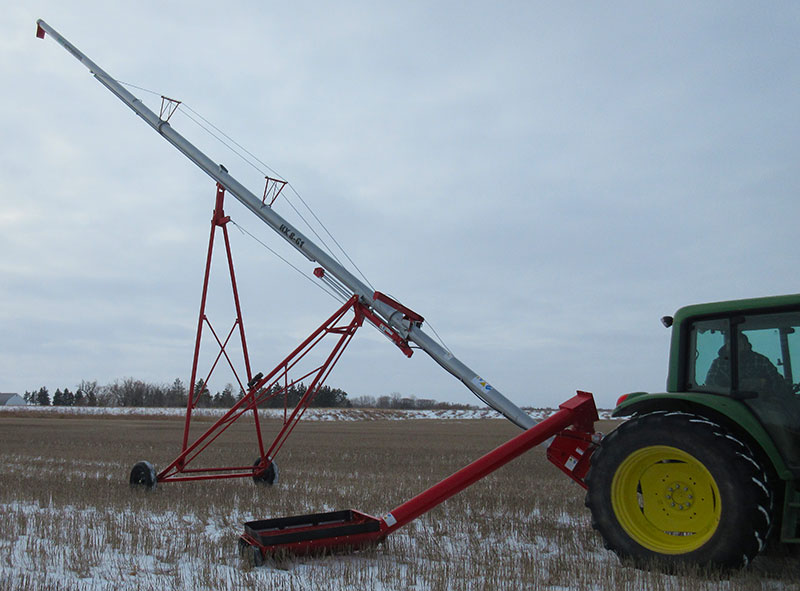
- Bucket elevators, conveyor belts, and enclosed screw conveyors — replaced manual handling and reduced contamination and spillage; together they form the backbone of modern material flow.
- Modern combines and harvest logistics — reduced field losses and enabled steadier throughput into trucks and bins. (Early combines were pioneered in the 1830s; rapid adoption came later as designs, power, and transport matured.)
- Aeration fans, low-energy dryeration systems, and precise dryer controls — reduced spoilage and energy waste compared with older, high-temperature drying.
- Flow aids and engineered hoppers — prevent bridging and ratholing, reducing manual cleanouts and downtime.
Put together, these are the components of efficient grain handling equipment — they lower energy bills, decrease shrink (loss), and let staff focus on value-added tasks rather than firefighting.
Common modern challenges — and how designers solve them
- Variable harvest windows & wet weather: Plan wet-holding, flexible wet-grain intake, and sufficient dryer capacity. Use sensor data to prioritize grain movement.
- Hotspots and hidden spoilage: Install permanent temperature/CO₂ monitoring and program automated aeration runs only when needed.
- Flow interruptions (bridging/ratholing): Use mass-flow silo designs, appropriate hopper angles, and flow aids; add access points and safe cleaning procedures.
- Safety hazards: Design for no-entry access where possible, train on entrapment risks, and use remote diagnostics to reduce bin entries.
All of these are core topics when we talk about grain handling system design with customers: layout, sequencing, sensor placement, and appropriate redundancy.
250 years of progress – National Ag Day 2026 
This year’s theme officially marks “250 years of progress in agriculture.” The annual observance organized by the Agriculture Council of America spotlights innovations across the supply chain — from the first mechanical reapers to today’s sensor networks and data-driven grain management.
What this history means for Valley View Agri-Systems customers
- Plan forward, design well. Use MWPS guidance and extension resources and the Valley View team when you begin planning to expand or rework a facility — the right layout saves decades of trouble.
- Invest selectively in monitoring. A modest sensor network often pays for itself by catching problems early.
- Upgrade to efficient grain handling equipment where it matters. Target conveyors, elevators, and flow aids that cut manual handling and losses.
- Treat drying and aeration as system problems. Dryer sizing, wet-holding, and aeration control should be designed together — that’s how you keep energy use and quality loss low.
At Valley View Agri-Systems we translate these lessons into site-specific plans — from full grain handling system design and equipment specification to sensor selection, aeration strategy, and operator training. Contact us to help you keep grain moving safely and profitably.